SEO vs GEO: What’s the Difference and Do You Need Both?
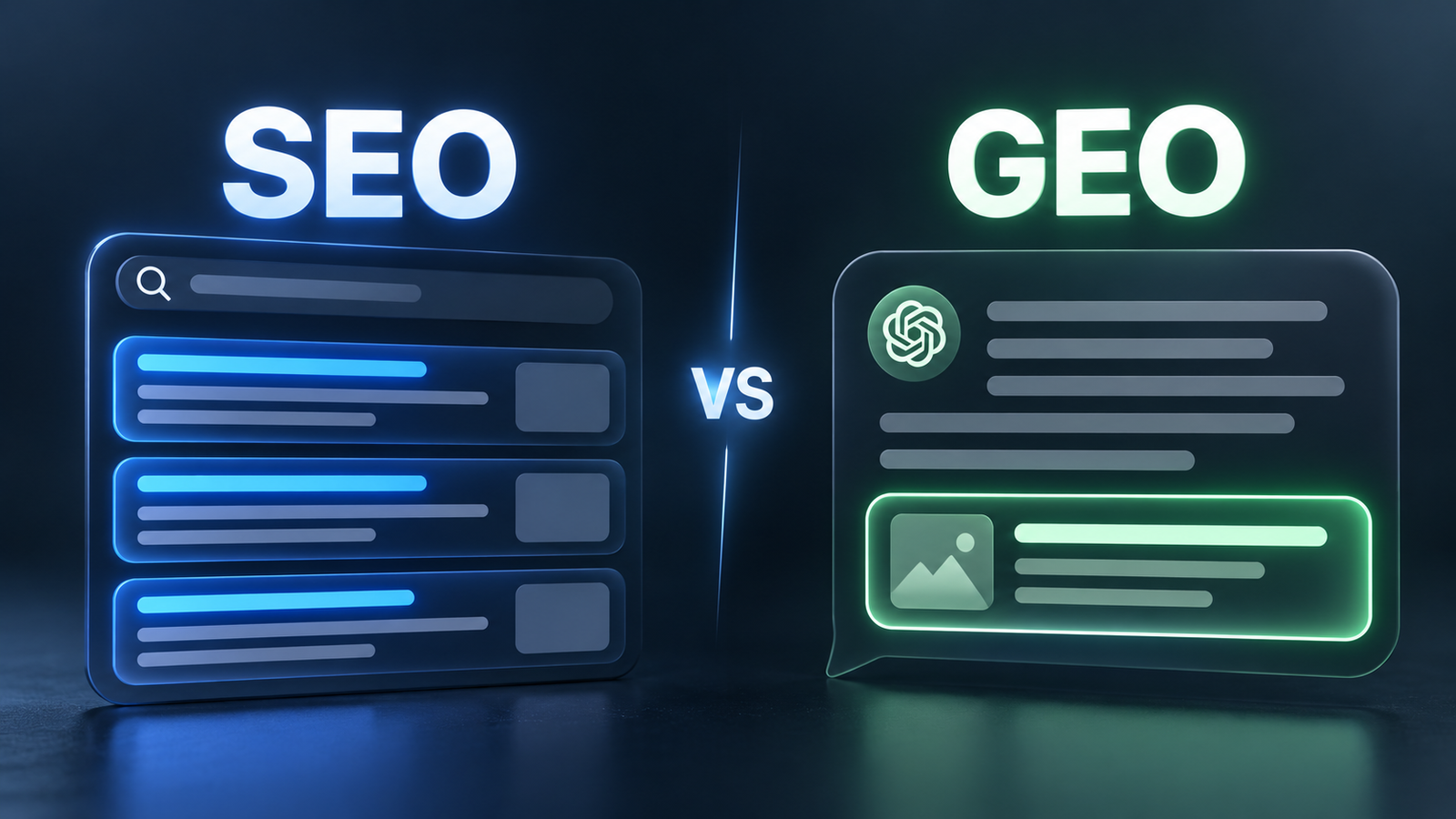
The short answer: The SEO vs GEO difference comes down to where you show up. SEO (Search Engine Optimization) gets your pages ranked in Google’s search results. GEO (Generative Engine Optimization) gets your content cited inside AI-generated answers from ChatGPT, Perplexity, Gemini, Claude and Google AI Overviews. SEO wins you a position. GEO wins you a mention. In 2026 you need both, because your audience now searches in both places, and ranking in one no longer guarantees you show up in the other.
That’s the SEO vs GEO debate in one paragraph. The rest of this guide shows you exactly how the two differ, where they overlap, what the latest data says, and how to run both without doubling your workload.
Key Takeaways
- SEO optimizes for rankings and clicks. GEO optimizes for citations and brand mentions inside AI answers.
- Google’s AI Overviews reach 2.5 billion monthly users, and ChatGPT passed 900 million weekly users in 2026. AI search is no longer a side channel.
- Ranking and being cited have split apart. Ahrefs found the share of AI Overview citations that also rank in Google’s top 10 fell from 76% to 38% in eight months.
- SEO is still the foundation. Google says its AI features run on the same core systems as regular search, with no special requirements.
- GEO is the layer on top: answer-first writing, cited statistics, clear entities, and a presence on the platforms AI engines trust.
What Is SEO?
SEO is the practice of making your pages easy for search engines to crawl, understand and rank, so they appear high in the list of results when someone searches a keyword.
It rests on three pillars:
- Technical SEO: your site loads fast, works on mobile, and can be crawled and indexed without errors.
- On-page SEO: your content matches search intent, targets the right keywords, and uses clear titles, headings and internal links. Our step-by-step keyword research guide shows how to pick the right ones.
- Off-page SEO: other sites link to you and mention you, which tells Google your content is trusted.
The goal of SEO is simple: rank, earn the click, and turn that visitor into a reader, lead or customer. Success is measured in rankings, impressions, click-through rate and organic traffic.
What Is GEO?
GEO (Generative Engine Optimization) is the practice of structuring and backing up your content so AI systems like ChatGPT, Perplexity, Gemini, Claude and Google AI Overviews understand it, trust it and cite it when they generate an answer.
The term comes from a 2023 research paper by a team from Princeton University, Georgia Tech, the Allen Institute for AI and IIT Delhi, later accepted at KDD 2024. They tested nine content changes across a benchmark of 10,000 real queries and found that the right changes boosted a source’s visibility in AI answers by up to 40%.
What worked best was not keyword tricks. It was evidence. Adding citations to credible sources, adding relevant statistics and adding quotations from experts produced the biggest lifts. Keyword stuffing, the oldest SEO shortcut there is, did little to nothing.
The most interesting finding: smaller sites gained the most. In the study, citing sources lifted the visibility of a website ranked fifth in the search results by 115%. GEO gives the underdog a real shot.
The goal of GEO: when someone asks an AI a question in your space, your brand, your data or your page is part of the answer.
SEO vs GEO: The Key Differences
| SEO | GEO | |
|---|---|---|
| Where you show up | Google and Bing results pages | ChatGPT, Perplexity, Gemini, Claude, Google AI Overviews and AI Mode |
| What you win | A ranking position | A citation or brand mention inside an answer |
| Unit of competition | The whole page | Individual passages, facts and entities |
| User behavior | Scans a list, clicks a result | Reads a synthesized answer, often without clicking |
| Main signals | Relevance, backlinks, technical health, intent match | Clear answers, verifiable facts, entity clarity, trusted mentions across the web |
| Content style that wins | Comprehensive, keyword-aligned pages | Direct, self-contained answers backed by sources and numbers |
| How you measure it | Rankings, CTR, organic traffic | Citation rate, share of voice in AI answers, AI referral traffic |
The biggest shift is the unit of competition. SEO ranks pages. AI engines pull passages. Your page can be excellent overall and still get skipped by ChatGPT if no single section answers the question cleanly on its own.
Why the Difference Matters in 2026
Two years ago, GEO was a nice-to-have. Look at the 2026 numbers and that argument is gone:
- Google AI Overviews: 2.5 billion monthly users, announced at Google I/O 2026.
- Google AI Mode: passed 1 billion monthly users within about a year of launch.
- ChatGPT: 900 million weekly active users as of February 2026, up from 400 million a year earlier.
AI answers are also changing how people click. A Pew Research Center study of nearly 69,000 real Google searches by 900 US adults found that when an AI summary appeared, users clicked a traditional result only 8% of the time, compared with 15% when no summary appeared. Just 1% clicked a source link inside the AI summary itself.
Here’s what that means in practice: a growing share of your audience gets their answer before they ever reach your blue link. If you’re not inside that answer, you’re invisible to them, even if you rank.
There is a flip side worth knowing. The visitors who do click through from AI tend to be further along in their decision. When Ahrefs analyzed its own traffic in 2025, AI referrals made up just 0.5% of visits but drove 12.1% of signups. Other studies show a smaller gap, and results vary by industry, but the direction is consistent: AI traffic is small and high intent.
Ranking Is No Longer the Same as Being Cited
This is the most important finding of the past year, and it’s the real reason SEO alone isn’t enough anymore.
In July 2025, Ahrefs found that about 76% of pages cited in Google AI Overviews also ranked in the organic top 10. When they re-ran the analysis in March 2026 across 863,000 keywords and 4 million cited URLs, that figure had dropped to 38%.
Why? When Google builds an AI Overview, it doesn’t just answer your exact query. It quietly runs a cluster of related sub-queries (Google calls this “query fan-out”) and pulls the best passage for each one. A page that ranks #14 for your main keyword but perfectly answers one of those sub-questions can get cited over the page ranking #1.
Outside Google, the gap is even wider. A Search Atlas study of 18,377 queries found ChatGPT’s cited domains overlapped with Google’s results only around 10 to 15% of the time. Perplexity, which searches the live web for every answer, overlapped more, at around 25 to 30%.
See it for yourself: search “best project management tool for small teams” in Google, then ask ChatGPT the exact same question. Compare the sources each one shows. In most cases the lists won’t match, and pages that don’t rank on page one of Google can still make ChatGPT’s shortlist. Same question, different winners.
But don’t overcorrect. Ranking still helps. A Conductor analysis of nearly 168 million AI Overview citations from June to August 2026 found the citation rate drops steadily as you go down the page, from 24.9% at position one to 10.2% at position ten. Ranking high raises your odds. It just doesn’t guarantee the citation anymore.
Where SEO and GEO Overlap
Here’s the part most “SEO is dead” posts get wrong: GEO is built on SEO, not instead of it.
Google says this directly in its own documentation. Its AI features use the same core ranking and quality systems as regular search, and there are no additional technical requirements to appear in AI Overviews or AI Mode. A page has to be indexed and eligible to show a snippet. That’s the entry ticket, and it’s pure SEO.
The overlap is big:
- Crawlability and indexing. If search engines and AI crawlers can’t access your page, you can’t rank and you can’t be cited.
- Helpful, original content. Both systems reward pages that answer the question better than anyone else.
- E-E-A-T. Experience, expertise, authority and trust signals help you rank, and they make AI engines more confident in citing you.
- Clear structure. Logical headings, short paragraphs and descriptive subheadings help Google understand your page and help AI engines extract passages from it.
- Topical authority. A cluster of strong content on one subject beats a single isolated post, in both systems.
If your SEO foundation is weak, GEO tactics won’t save you. Fix the foundation first.
What GEO Adds on Top of SEO
Once the foundation is solid, these are the moves that specifically lift your AI visibility:
- Lead every section with the answer. Put the direct answer in the first one or two sentences, then add context. AI engines extract answers. Don’t make them dig.
- Back claims with numbers and named sources. “According to Ahrefs’ March 2026 study of 863,000 keywords” is citable. “Studies show” is not. This is exactly what the Princeton research found works best.
- Write self-contained passages. Each section should make sense on its own, without “as mentioned above” or a pronoun that only resolves three paragraphs earlier.
- Define your entities clearly. State plainly what your brand, product or concept is, and describe it the same way everywhere: your site, your About page, your social profiles and third-party listings.
- Earn mentions where AI looks. Reddit, YouTube, LinkedIn, review sites and industry publications show up again and again in AI citation studies. A mention there can matter as much as a backlink.
- Add structured data. Article, FAQ, Organization and author schema give machines an unambiguous summary of who you are and what your page covers.
- Keep content fresh. AI engines lean on current sources, especially for anything with “2026” in the question. Update dates, numbers and examples on your key pages.
Do You Need Both?
Yes. The only question is how you split your effort, and that depends on your business.
Local businesses (plumbers, clinics, restaurants): SEO and Google Business Profile still drive most of your calls. Spend around 80% on SEO and local SEO. Use GEO to make sure AI tools describe your services, location and reviews correctly.
Bloggers and publishers: you’re the most exposed to zero-click answers on simple informational queries. Keep SEO as the engine, but shift your content toward original data, first-hand experience and opinion, the things an AI summary can’t replace and has to cite.
SaaS and B2B companies: your buyers increasingly ask AI tools for shortlists (“best X for Y”, “X vs Y”). If you’re not in those answers, you’re not on the shortlist. Treat GEO as a core channel next to SEO, roughly a 60/40 split.
E-commerce brands: product and category SEO still carries most of the revenue. Add GEO to your buying guides and comparison content, because that’s where AI shopping recommendations pull from.
The worst choice in 2026 is picking one and ignoring the other. SEO without GEO leaves you invisible in a fast-growing channel. GEO without SEO has no foundation to stand on.
How to Start Doing Both: A 5-Step Plan
You don’t need two separate teams. You need one workflow that covers both.
- Audit your top 10 pages. Check rankings and technical health for SEO. Then ask ChatGPT, Perplexity and Google the questions those pages target, and note whether you’re cited, mentioned or missing.
- Fix the foundation. Resolve indexing, speed and mobile issues. Make sure AI crawlers aren’t accidentally blocked in your robots.txt.
- Rewrite for extraction. Put the direct answer at the top of each section, replace vague claims with sourced numbers, and make each passage stand on its own.
- Build entity consistency. Align how your brand is described across your website, social profiles, directories and press mentions.
- Track both, monthly. Rankings and traffic for SEO. Citations and AI referrals for GEO. Re-test the same questions every month, because AI answers change.
How to Measure SEO and GEO
| What to track | SEO | GEO |
|---|---|---|
| Visibility | Keyword rankings, impressions | How often you’re cited or mentioned for your target questions |
| Traffic | Organic sessions in GA4 and Search Console | Referral sessions from chatgpt.com, perplexity.ai, gemini.google.com and others |
| Share of voice | Ranking share against competitors | Mention share against competitors in AI answers |
| Outcomes | Leads, sales, signups from organic | Leads, sales, signups from AI referrals |
One measurement trap to know: clicks from Google AI Overviews and AI Mode are counted as normal Google search traffic in Search Console, so you can’t separate them out there. For ChatGPT, Perplexity and the rest, set up a custom channel group in GA4 that pulls their referral traffic into one “AI search” bucket.
FAQ
Is GEO replacing SEO?
No. GEO is built on top of SEO. Google’s AI features use the same core ranking systems as regular search, and pages still need to be indexed and crawlable to be cited anywhere. GEO adds new techniques for AI answers, but it doesn’t remove the need for SEO.
Is GEO the same as AEO or AI SEO?
Mostly, yes. AEO (Answer Engine Optimization), AI SEO, LLMO and GEO describe the same goal: getting your content into AI-generated answers. GEO is the term used in the original Princeton research and is the most common in 2026.
Can I rank #1 on Google and still not appear in ChatGPT?
Yes, and it happens often. A Search Atlas study of 18,377 queries found the domains ChatGPT cites overlap with Google’s results only around 10 to 15% of the time. Ranking helps your odds in Google AI Overviews, but it does not guarantee a citation in other AI tools.
How long does GEO take to show results?
Often faster than SEO. Perplexity and ChatGPT search pull live web content, so a well-structured, well-sourced update can start getting cited soon after it’s crawled. Changes in what AI models “know” without searching take longer, because those depend on training data.
Do I need a separate tool for GEO?
Not necessarily, but you need a way to measure it. Traditional SEO tools track rankings, not AI citations. You can test manually by asking AI tools your target questions every month, or use a tool that scores your content for AI visibility and tracks citations across platforms.
The Bottom Line
SEO and GEO aren’t competitors. They’re two halves of the same job in 2026: being found.
SEO makes sure search engines can find, understand and rank your content. GEO makes sure AI engines can understand, trust and quote it. The foundation is the same. The finish line is different.
Start with SEO, because nothing works without it. Then layer GEO on top: answer first, back every claim with a source, keep every passage self-contained, and get your brand mentioned where AI engines look.