What Is GEO? A Beginner’s Guide to Generative Engine Optimization
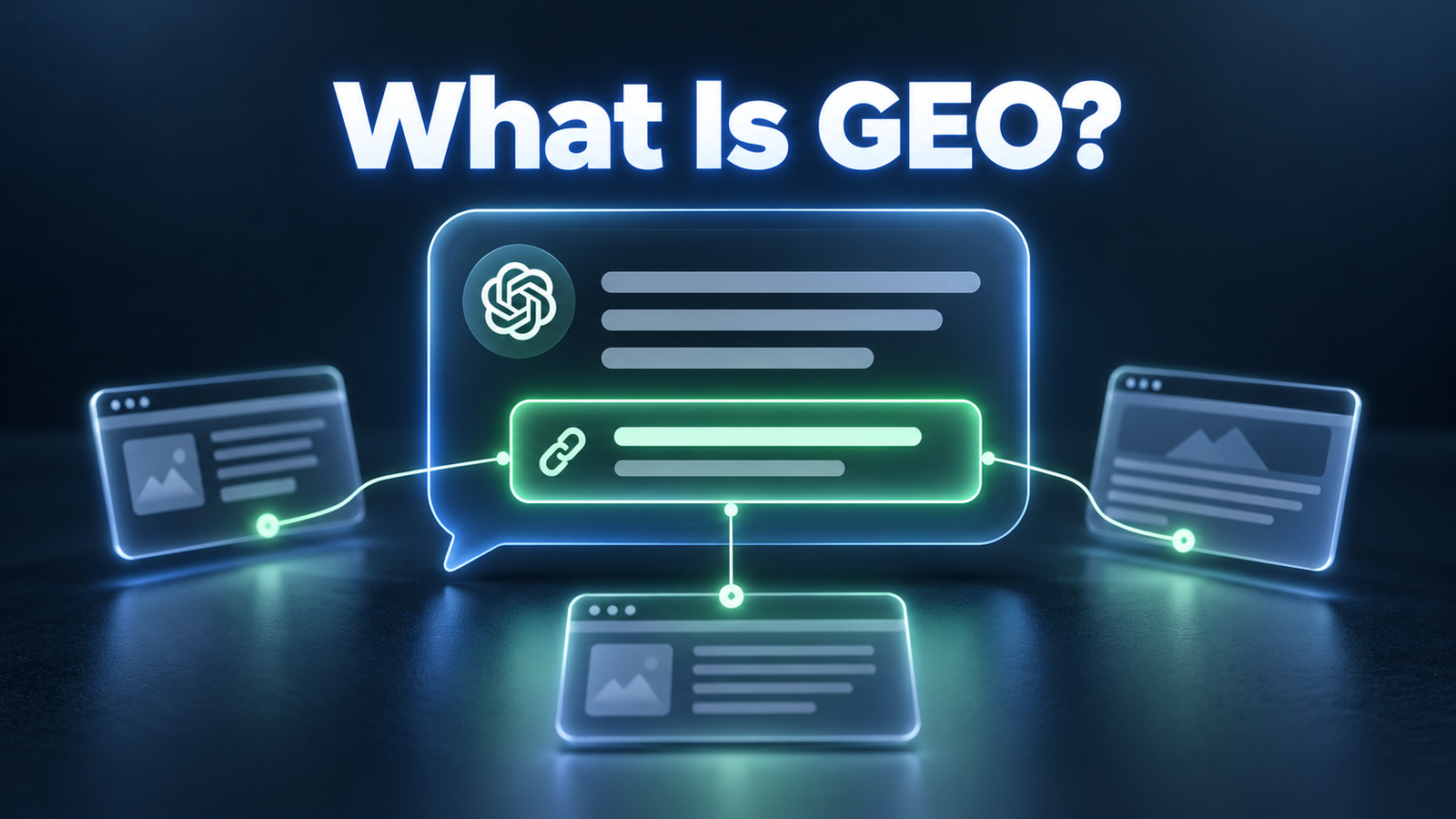
What is GEO? GEO (Generative Engine Optimization) is the practice of making your content easy for AI tools like ChatGPT, Perplexity, Gemini, Claude and Google AI Overviews to find, trust and cite when they answer a question. Traditional SEO helps you rank in a list of links. GEO helps you become part of the answer itself.
New to the term? Start with our beginner’s guide to GEO.
If you’ve ever asked ChatGPT for a recommendation and noticed it named three brands and linked two websites, you’ve seen GEO in action. Those brands and websites earned their spot. This guide shows you how that works, what actually moves the needle, and how to start, even if you’ve never heard the term before today.
Key Takeaways
- GEO is about getting cited and mentioned inside AI-generated answers, not just ranked in search results.
- The audience is huge: Google AI Overviews reach 2.5 billion monthly users, and ChatGPT has 900 million weekly users.
- AI engines reward evidence: specific facts, named sources and statistics. Keyword stuffing does little to nothing.
- GEO sits on top of SEO. If search engines can’t crawl and index your page, AI engines can’t use it either.
- You don’t need special files or tricks. Clear answers, real expertise, and a presence on the sites AI engines trust do the heavy lifting.
GEO in One Sentence
GEO is SEO for answers instead of rankings.
You’ll also hear it called AEO (Answer Engine Optimization), AI SEO, LLMO (Large Language Model Optimization) or AI search optimization. They all describe the same goal. GEO is the name used in the original research, and it’s the one that has stuck.
If you want the full side-by-side comparison, read our guide on SEO vs GEO: What’s the Difference and Do You Need Both?. In short: SEO wins you a position on the results page, and GEO wins you a mention inside the answer.
Where GEO Applies
GEO covers every tool that writes an answer instead of showing a list of links. The big ones in 2026:
| AI engine | How big it is | How it finds sources |
|---|---|---|
| Google AI Overviews | 2.5 billion monthly users | Google’s own search index |
| Google AI Mode | 1 billion+ monthly users | Google’s own search index |
| ChatGPT | 900 million weekly users | Its own search crawler plus training data |
| Gemini | 900 million+ monthly users | Google’s index plus training data |
| Perplexity | 45 million monthly users | Live web search on almost every question |
| Claude | Growing fast, popular for work tasks | Web search when needed plus training data |
Each engine picks sources a little differently, which is why the same question can produce different citations in each one. But the content that wins is remarkably consistent across all of them.
Where the Term GEO Came From
GEO isn’t a marketing buzzword someone invented for a sales pitch. It started as research.
In late 2023, researchers from Princeton University, Georgia Tech, the Allen Institute for AI and IIT Delhi published a paper called GEO: Generative Engine Optimization, later accepted at KDD 2024, one of the top data science conferences. They built a benchmark of 10,000 real search queries and tested nine ways of rewriting content to see what made AI engines cite it more.
The results:
- The best methods boosted a source’s visibility in AI answers by up to 40%.
- The winners were adding citations, adding statistics and adding quotations from credible sources.
- Keyword stuffing did little to nothing.
- Lower-ranked sites gained the most. A website ranked fifth in the search results saw its visibility jump by 115% just from citing its sources.
That last point matters for beginners. GEO is one of the few areas of search where a small site with strong, well-sourced content can beat a much bigger competitor.
How AI Engines Decide What to Cite
To do GEO well, you need a basic picture of how an AI engine builds an answer. There are two paths.
Path 1: What the model already knows. AI models are trained on huge amounts of web content. If your brand is mentioned often and consistently across the web, the model “knows” about you and may mention you even without searching. This path is slow to change, because it depends on training data.
Path 2: What the engine searches for right now. Google AI Overviews and Perplexity search the web for every answer. ChatGPT and Gemini search when a question needs current or specific information, which includes most buying and comparison questions. They read the top sources and write an answer from them. This is where most GEO wins happen, and it changes much faster than Path 1.
Two details about Path 2 change how you should write:
- AI engines run many searches, not one. Google calls this “query fan-out.” When someone asks a complex question, the engine quietly splits it into several related sub-questions and searches each one. Your page can get cited for a sub-question even if it doesn’t rank for the main one. That’s part of why Ahrefs found that only 38% of Google AI Overview citations now come from pages in the organic top 10, down from 76% in mid-2025.
- AI engines quote passages, not pages. The engine pulls the one paragraph that answers its sub-question best. A page can be great overall and still lose if no single section answers clearly.
Why GEO Matters Now
Two numbers explain why businesses started paying attention.
First, AI answers reduce clicks. A Pew Research Center study found that when Google showed an AI summary, people clicked a regular search result only 8% of the time, compared with 15% when no summary appeared. If you’re not in the answer, many people never see you.
Second, the visitors AI does send are valuable. When Ahrefs analyzed its own traffic, AI search sent just 0.5% of visitors but 12.1% of signups. People who click through from an AI answer have usually already compared their options. They arrive ready to act.
Fewer clicks, but better ones. Being cited is how you get them.
The 7 Core Principles of GEO
These are the fundamentals. Get them right and you’re ahead of most websites.
1. Answer first, explain second
Start every section with a direct answer in one or two sentences, then add detail. AI engines look for the sentence that answers the question. Don’t bury it under an introduction.
2. Back every claim with evidence
Specific beats vague, every time.
- Weak: “Most people now use AI tools for search.”
- Strong: “ChatGPT reached 900 million weekly users in February 2026, more than double its 400 million a year earlier.”
The strong version gives the AI engine a fact it can verify and cite. This is exactly what the Princeton study found works best.
3. Make each section stand on its own
Write so any section makes sense if it’s the only thing someone reads. Name the subject instead of writing “it” or “this,” and avoid “as we mentioned above.” This isn’t about chopping your content into tiny pieces. It’s just clear writing, and it makes your passages easy to quote.
4. Be clear about who you are
AI engines need to understand your brand as an entity: what it is, what it does and who it’s for. Describe yourself in plain words on your homepage and About page, and use the same description everywhere: social profiles, directories and guest posts. Inconsistent descriptions confuse AI engines and make them less likely to recommend you.
5. Get mentioned where AI engines look
AI engines don’t only cite websites. A Peec AI analysis of about 30 million AI citations found the most-cited domains across ChatGPT, Google AI Mode, Gemini, Perplexity and AI Overviews were Reddit, YouTube, LinkedIn and Wikipedia, followed by sites like Forbes and G2. Genuine mentions and helpful answers on those platforms can feed straight into AI answers.
6. Show real experience
AI engines and Google both favor content that shows first-hand knowledge: your own data, screenshots, results and opinions. Anyone can rewrite a definition. Only you can share what happened when you tested something.
7. Keep it fresh
AI engines prefer current information, especially for questions that include a year. Update the numbers, dates and examples on your most important pages regularly, and show a visible “last updated” date.
The Technical Basics: Let AI Crawlers In
All the great content in the world won’t help if AI engines can’t read it. Each AI company uses its own crawlers, and your robots.txt file decides which ones get in.
| Crawler | Company | What it does | What blocking it means |
|---|---|---|---|
| Googlebot | Crawls for Google Search, AI Overviews and AI Mode | You disappear from Google entirely | |
| OAI-SearchBot | OpenAI | Finds pages for ChatGPT search answers | You can drop out of ChatGPT search |
| GPTBot | OpenAI | Collects content for training OpenAI models | Opts you out of training only, not ChatGPT search |
| PerplexityBot | Perplexity | Finds pages for Perplexity answers | You can drop out of Perplexity |
| Claude-SearchBot | Anthropic | Finds pages for Claude’s search answers | You can drop out of Claude’s answers |
| ClaudeBot | Anthropic | Collects content for training Claude | Opts you out of training |
| Google-Extended | A control setting, not a separate crawler. Decides if Gemini apps and Google’s AI models can use your content | No effect on Google Search or AI Overviews |
The beginner rule: if you want to be cited, don’t block the search crawlers (Googlebot, OAI-SearchBot, PerplexityBot, Claude-SearchBot). Blocking the training crawlers is a business choice and doesn’t remove you from search answers.
To check yours, open yoursite.com/robots.txt in a browser. If you see Disallow: / under any of those search crawlers, that’s a problem worth fixing today. Some security plugins and hosting firewalls also block AI bots by default, so check those settings too.
GEO Myths Beginners Should Ignore
The GEO space is full of shortcuts that sound smart and don’t work.
Myth 1: “You need an llms.txt file.” llms.txt is a proposed file that summarizes your site for AI tools. Google’s own AI search guidance, published in May 2026, tells site owners they don’t need llms.txt or any special AI files to appear in Google’s AI features. It’s harmless to add one, but it won’t get you cited on its own.
Myth 2: “Rewrite everything into short AI-friendly chunks.” The same Google guide lists content chunking and AI-specific rewriting among the things you don’t need. Write clear sections for humans. That’s what AI engines want too.
Myth 3: “Repeat the keyword more.” The Princeton research found keyword stuffing does little to nothing for AI visibility. AI engines understand meaning, not just matching words.
Myth 4: “GEO replaces SEO.” It doesn’t. Google says its AI features run on the same core systems as regular search. If your page isn’t indexed, it can’t be cited. SEO is the foundation and GEO is the layer on top.
A Simple Before and After Example
Here’s what GEO looks like on a real paragraph. Imagine a section answering “How long does SEO take to work?”
Before:
SEO is a long-term strategy, and results depend on many different factors. Every website is unique, so it’s hard to give an exact timeline. In this section we’ll look at some of the things that affect how quickly you might see results.
Three sentences, zero answers. An AI engine has nothing to quote.
After:
SEO usually takes 3 to 6 months to show meaningful results for a new page, and 6 to 12 months for competitive keywords. The biggest factors are your site’s authority, the competition for the keyword, and how often you publish. Newer sites with few backlinks sit at the slower end of that range.
The answer comes first, with specific numbers, and the paragraph makes sense on its own. In a real article, you’d also link a source for those numbers. That’s GEO.
How to Start With GEO: A 30-Minute Checklist
You don’t need a big budget to begin. Block out 30 minutes and work through this:
- Test your visibility. Ask ChatGPT, Perplexity and Google three questions your customers ask. Note whether your brand or site appears.
- Check your robots.txt. Make sure Googlebot, OAI-SearchBot, PerplexityBot and Claude-SearchBot aren’t blocked.
- Pick your best page. Choose the one page that matters most to your business.
- Rewrite the opening. Put a clear, direct answer in the first two sentences.
- Add one fact. Replace your vaguest claim with a specific number and a named source.
- Fix your About page. Describe what you do in one plain, clear sentence, and use that same sentence on your social profiles.
- Set a reminder. Re-run step 1 in 30 days and compare.
How to Measure GEO
GEO is harder to measure than SEO, because there’s no single “AI ranking” report. Track these instead:
- Citation checks: Ask the same set of questions in each AI engine every month and log whether you’re cited, mentioned or missing. Our guide on how to track your brand in ChatGPT and AI search walks through the full setup.
- AI referral traffic: In Google Analytics 4, look for sessions from chatgpt.com, perplexity.ai, gemini.google.com and claude.ai. Group them into a custom “AI search” channel.
- Branded search: People who discover you in an AI answer often search your brand name on Google afterwards. A rise in branded searches in Search Console is a good sign.
One limitation to know: clicks from Google AI Overviews and AI Mode are counted as regular Google search traffic in Search Console, so you can’t separate them there.
FAQ
What does GEO stand for?
GEO stands for Generative Engine Optimization. “Generative engines” are AI tools that generate an answer, like ChatGPT, Perplexity, Gemini, Claude and Google AI Overviews. GEO is the practice of optimizing your content so these tools cite it.
Is GEO the same as SEO?
No, but they’re closely connected. SEO helps you rank in search results. GEO helps you get cited inside AI answers. GEO builds on SEO, because AI engines mostly pull from pages that search engines can already crawl and index.
Is GEO the same as AEO?
Yes, for practical purposes. GEO, AEO (Answer Engine Optimization), AI SEO and LLMO all describe optimizing content for AI-generated answers. GEO is the term from the original Princeton research.
Can a small website do GEO?
Yes, and small sites often benefit most. The Princeton study found lower-ranked sites gained the biggest visibility boosts from GEO techniques like citing sources. Clear answers and strong evidence matter more than domain size.
How long does GEO take to work?
It depends on the path. Engines that search the live web, like Perplexity and ChatGPT search, can start citing an improved page soon after it’s crawled. Getting AI models to “know” your brand without searching takes much longer, because that depends on future training data.
Do I need special tools for GEO?
Not to start. You can test manually by asking AI tools your target questions. As you grow, a tool that scores your content for AI readiness and tracks citations across engines saves a lot of time.
The Bottom Line
GEO is how you show up in the answers people now get from AI. The good news for beginners is that it isn’t magic. AI engines want what readers want: clear answers, real evidence and sources they can trust.
Start with the basics. Make sure AI crawlers can reach your site, lead every section with a direct answer, back your claims with specific facts, and get your brand mentioned where AI engines look. Do that consistently, and you’ll be part of the answer while your competitors are still wondering where their clicks went.