How to Get Cited in Google AI Overviews: 7 Proven Tactics
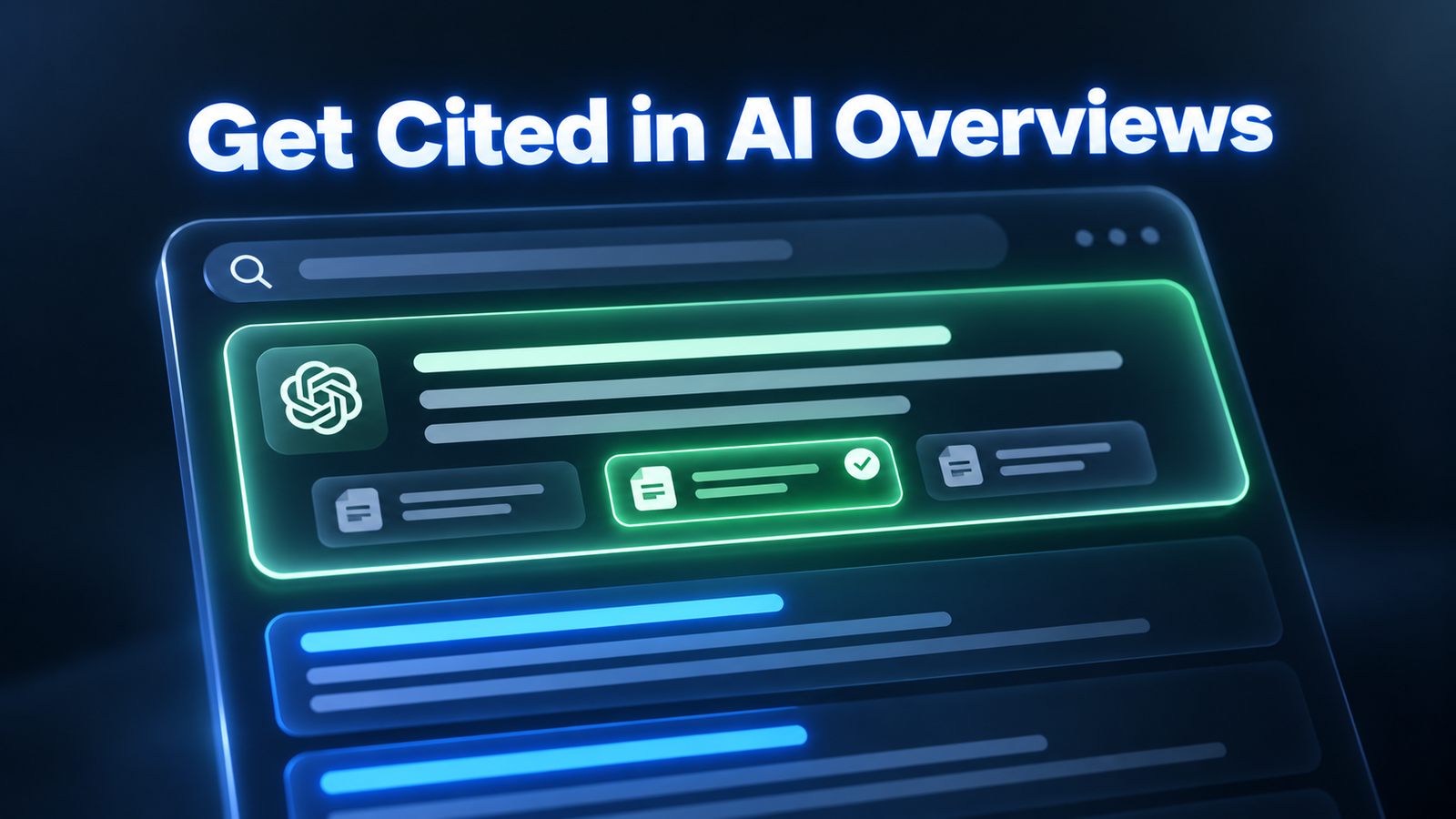
The short answer: To get cited in Google AI Overviews, make sure your page is indexed and eligible for snippets, rank it as high as you can, cover the related questions people ask around your topic, and answer each one in a clear, evidence-backed passage. Then build your presence on YouTube and community platforms, which AI Overviews cite constantly. There’s no secret switch. Google picks the sources that answer each part of the question best.
Google AI Overviews now reach 2.5 billion people a month, more than any other AI answer engine. When one appears, it sits above every organic result. If your page is cited inside it, you’re the first source people see. If it isn’t, you’re competing for the clicks that are left.
Below are seven tactics that are backed by data, plus the shortcuts you can safely ignore.
Key Takeaways
- AI Overviews only cite pages that are indexed and allowed to show a snippet. That’s the entry ticket.
- Ranking still helps. Position one gets cited about 2.5 times as often as position ten.
- But most citations come from outside the top 10, because Google answers a cluster of related sub-questions, not just your keyword.
- Pages win with clear, self-contained answers backed by specific facts.
- YouTube is the most-cited domain in AI Overviews. Video is a real opening most sites ignore.
How Google Picks AI Overview Sources
Before the tactics, you need to know what you’re optimizing for.
When an AI Overview triggers, Google doesn’t only search your exact query. It runs what it calls a query fan-out: it splits the question into several related sub-questions, searches each one, and pulls the best passage for each part of the answer.
That changes the game. In mid-2025, about 76% of AI Overview citations came from pages ranking in Google’s top 10. By March 2026, Ahrefs found that figure had dropped to 38%. A newer Conductor analysis of nearly 168 million citations from June to August 2026 put it at 43%. Either way, most AI Overview citations now go to pages outside the top 10.
So there are two ways in: rank for the main keyword, or be the best answer to one of the sub-questions. The tactics below cover both.
Where AI Overviews show up: estimates range from about 30% to nearly half of US searches, depending on the keywords each study tracks. Question-style and informational searches (“what is”, “how to”, “X vs Y”) trigger them far more often than shopping or local searches. If your content answers questions, you’re in the zone where AI Overviews live.
Tactic 1: Make Sure Your Page Is Eligible
This sounds basic, but check it before anything else. A single setting can quietly lock you out.
Google’s documentation on AI features is clear: to be shown as a link in AI Overviews or AI Mode, a page must be indexed and eligible to be shown in Google Search with a snippet. There are no extra technical requirements beyond that.
Check three things:
- The page is indexed. Paste the URL into Search Console’s URL Inspection tool. If it says “URL is not on Google,” fix that first.
- You’re not blocking snippets. A
nosnippetrobots meta tag also stops your content from being used in AI Overviews and AI Mode. A very lowmax-snippetvalue limits how much Google can use. Some SEO plugins and themes add these without you noticing. - Googlebot can crawl the page. Check your robots.txt and make sure no security plugin or firewall blocks Google.
If any of these fail, nothing else in this guide matters.
Tactic 2: Rank as High as You Can
Ranking is no longer a guarantee, but it still clearly raises your odds.
Conductor’s 2026 data shows the citation rate falls steadily as you move down the page: pages in position one were cited 24.9% of the time, compared with 10.2% at position ten. That’s roughly 2.5 times the citation odds for being at the top.
This is why GEO doesn’t replace SEO. Google’s AI features run on the same core ranking systems as regular search. Every improvement that lifts your ranking (better content, stronger links, faster pages, clearer intent match) also lifts your odds of being cited.
If you’re new to this, our guide on SEO vs GEO explains how the two work together.
Tactic 3: Cover the Questions Around Your Topic
This is the tactic that wins citations outside the top 10.
Because of query fan-out, an AI Overview for “how to start a blog” might also pull answers to “how much does a blog cost,” “best blogging platform” and “how bloggers make money.” The page that answers one of those sub-questions best can earn a citation, even if it ranks on page two for the main query.
How to find the sub-questions:
- People Also Ask: search your main keyword in Google and open every “People also ask” question. They’re a good guide to the related questions Google connects to your topic.
- AI Mode: ask your main question in Google AI Mode and look at what it covers. Each section points to a sub-question.
- Your own AI Overview: read the current AI Overview for your keyword. Each point shows a sub-question Google thinks matters, and the cited sources show who’s winning it right now.
Then make sure your page answers each relevant sub-question in its own clearly labeled section, with a subheading phrased close to how people actually ask it.
Tactic 4: Write Answer-First Passages
AI Overviews quote passages, not whole pages. Make each passage easy to lift.
- Put the answer in the first one or two sentences of each section, then add detail.
- Make each section stand on its own. Name the subject instead of writing “it” or “as mentioned above.”
- Use clear structure: short paragraphs, descriptive subheadings, numbered steps for processes, and tables for comparisons.
Here’s the difference:
Hard to cite:
There are lots of things to think about when it comes to blog costs, and everyone’s situation is different, so let’s go through the main factors.
Easy to cite:
Starting a blog costs between $50 and $300 in the first year for most beginners. The main costs are a domain name (about $10 to $20 a year), hosting ($3 to $15 a month) and an optional premium theme ($50 to $100 one time).
The second version answers the question in the first sentence. That’s the one Google can quote. (In a real article, link a source for prices like these.)
Tactic 5: Back Your Claims With Evidence
AI systems favor content they can trust and verify.
The Princeton research that defined GEO tested nine ways of improving content for AI engines across 10,000 queries. The three best performers were citing credible sources, adding statistics and adding quotations from experts, which boosted visibility by up to 40%. Keyword stuffing did little to nothing.
In practice:
- Replace “many studies show” with the actual study, its date and a link.
- Add specific numbers wherever you make a claim.
- Quote a recognized expert when you can.
- Show first-hand experience: your own tests, screenshots and results. Google’s quality systems reward experience and expertise, and AI Overviews draw from those same systems.
Tactic 6: Create a YouTube Video for Your Topic
This is the tactic most websites overlook.
YouTube is the single most-cited domain in Google AI Overviews. A late-October 2026 snapshot from LLM Pulse found YouTube cited in about 37% of the AI Overviews it tracked that included sources, ahead of Facebook, Instagram and Reddit.
You don’t need a big channel to benefit. For your most important topics:
- Make a short, focused video that answers the main question directly in the first 30 seconds.
- Use the question as the title, written the way people search it.
- Add accurate captions or a transcript, so Google can understand exactly what you say.
- Embed the video in your matching blog post, so the page and the video support each other.
Tactic 7: Build Your Presence on Community Platforms
After YouTube, the most-cited domains in AI Overviews in that same LLM Pulse snapshot were social and community sites: Facebook, Instagram, Reddit, LinkedIn, TikTok and Quora.
These platforms hold what articles often lack: real experiences and opinions from real people. That’s likely why AI Overviews lean on them. Use that:
- Answer questions on Reddit and Quora where you have real expertise. Be genuinely helpful and don’t spam links. A useful answer can be cited on its own.
- Publish your insights on LinkedIn as posts and articles, especially original data or results.
- Keep your brand described the same way everywhere, so Google connects your mentions to one clear entity.
The same platforms matter for ChatGPT too. See our guide on how to get cited by ChatGPT.
What Doesn’t Work (Skip These)
Save your time. These shortcuts don’t move AI Overview citations:
- Faking freshness. Changing the date without changing the content doesn’t help. A 2025 Ahrefs study of 17 million AI citations found that most AI assistants favored fresher content, but Google AI Overviews were the exception: their citations were about as old as regular organic results. Update content when the facts change, not to game a date.
- llms.txt and special AI files. Google’s AI search guidance says you don’t need special files to appear in its AI features. Our guide on what llms.txt is explains why.
- Special AI schema. Google says no special structured data is required for AI Overviews. Structured data still helps with regular rich results, so keep it, but don’t expect it to unlock citations.
- Keyword stuffing. It didn’t help in the Princeton research, and it makes your content worse for readers.
How to Check If You’re Cited
Google doesn’t offer an AI Overviews report, so you have to check in a few ways:
- Manual checks: search your target keywords in a private browser window, open the AI Overview, and click the source icons. Note whether your page appears. Results can vary by location and session, so check the same set of keywords every month.
- Search Console: clicks and impressions from AI Overviews are included in your normal search performance data. You can’t separate them, but rising impressions on question keywords where AI Overviews appear is a good sign.
- Tracking tools: several SEO tools now track AI Overview citations across many keywords at once, which saves hours of manual checking.
FAQ
Do I need to rank #1 to get cited in AI Overviews?
No. Most AI Overview citations now come from pages outside the top 10, because Google also answers related sub-questions. Ranking high still improves your odds: Conductor found position one was cited 24.9% of the time compared with 10.2% at position ten.
How long does it take to get cited in an AI Overview?
There’s no fixed timeline. Your page has to be crawled and indexed first, and AI Overviews can change from one day to the next. Updated pages are often picked up after Google recrawls them, so request indexing in Search Console after major updates.
Can I stop Google from using my content in AI Overviews?
Yes. Adding the nosnippet robots meta tag prevents your content from being used as a direct input for AI Overviews and AI Mode. But it also removes your text snippets from regular search results, so most sites shouldn’t use it.
Does schema markup help with AI Overviews?
Not directly. Google says no special structured data is needed to appear in AI Overviews. Schema still helps search engines understand your page and can earn rich results, so it’s worth keeping for SEO.
Are AI Overviews the same as AI Mode?
No. AI Overviews appear automatically at the top of regular Google results. AI Mode is a separate, conversational search experience you open on purpose. They can use different models and techniques, so they don’t always cite the same sources, but the same fundamentals help you appear in both.
The Bottom Line
Getting cited in Google AI Overviews isn’t about tricks. It’s about being the clearest, most trustworthy answer to each part of a question.
Make sure your page is eligible. Rank as high as you can. Cover the sub-questions around your topic, answer each one first and clearly, and back it with real evidence. Then show up where Google looks most: YouTube and the community platforms your audience already uses.
New to all of this? Start with our beginner’s guide to GEO.