How to Track Your Brand in ChatGPT and AI Search
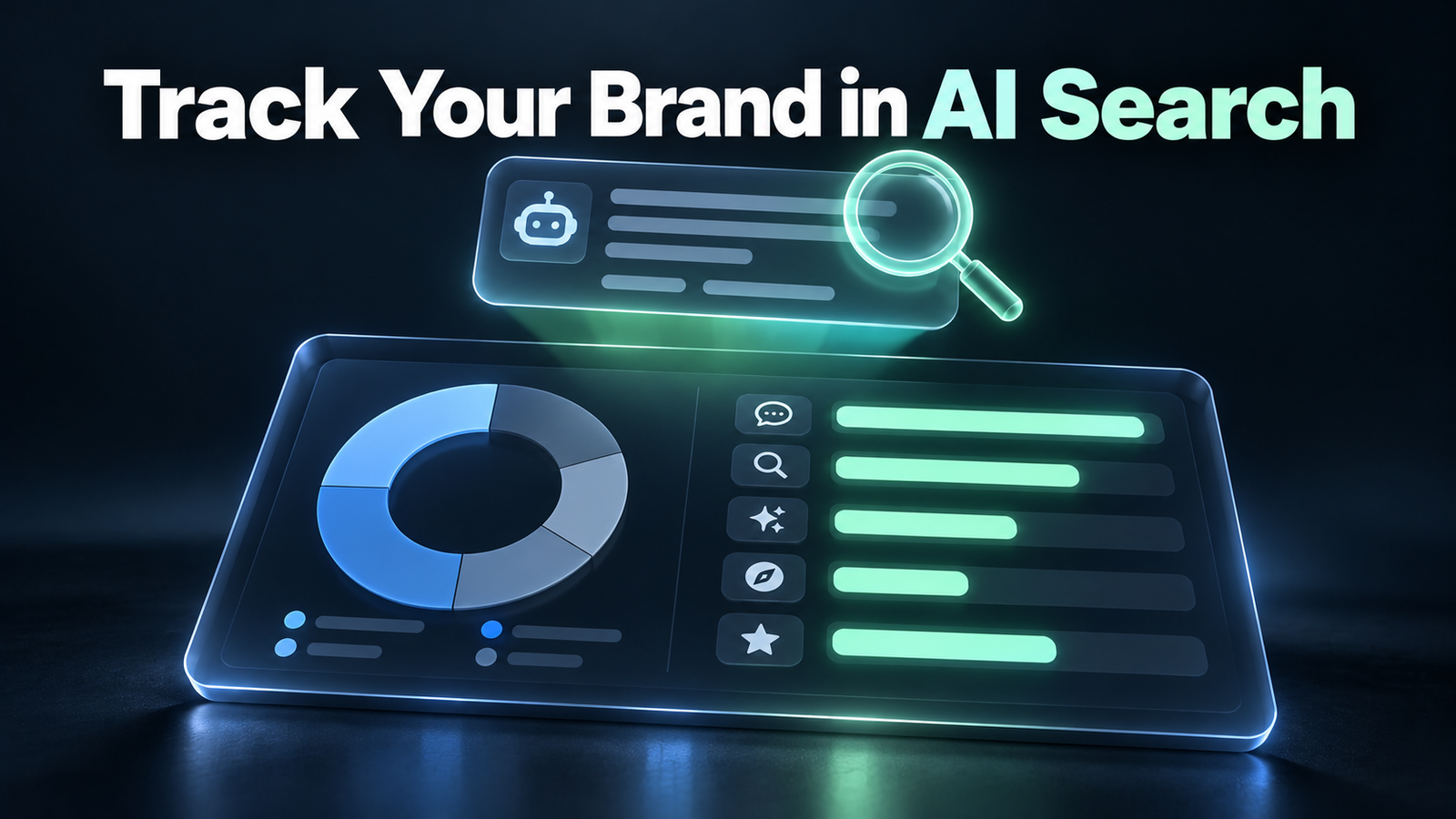
The short answer: To track your brand in ChatGPT and AI search, build a list of the prompts your buyers actually ask, run them on ChatGPT, Google AI Overviews, Gemini, Perplexity and Claude, and record whether each answer cites you, mentions you, or leaves you out. Repeat the same prompts every week, because AI answers change from one run to the next. The number that matters isn’t your “rank.” It’s how often you show up.
Your Google rankings can’t tell you any of this. You can rank #1 for a keyword and still be missing from every AI answer about it. This guide shows you exactly what to measure, how to set it up, and how to read the results, including a real example where the headline number looked great and the real picture didn’t.
Key Takeaways
- Track visibility, not rank. AI answers reshuffle constantly, so the useful number is how often you appear across many prompts and runs.
- Build prompts by type: recommendation, comparison, informational and brand prompts each tell you something different.
- Brand prompts flatter you. Being cited when someone asks for you by name is easy. Being recommended when they don’t is the real test.
- A high Share of Voice can hide a problem. If AI rarely mentions any brand you track, your share looks huge while your visibility stays tiny.
- Check citations, not just mentions. The sources AI uses tell you exactly where to build your presence.
Why Your Google Rankings Don’t Show This
AI search and Google rankings now pick very different winners.
- In March 2026, Ahrefs found that only 38% of Google AI Overview citations came from pages ranking in the top 10, down from 76% the year before.
- Outside Google the gap is wider. A Search Atlas study of 18,377 queries found the domains ChatGPT cites overlap with Google’s results only around 10 to 15% of the time.
So a rank tracker can show you winning while AI tools recommend your competitors. If you’re new to this side of search, start with our guide on what GEO is.
Why You Can’t Track AI “Rankings”
Before you set anything up, accept one fact: AI answers are not stable lists.
In a January 2026 study, SparkToro’s Rand Fishkin and Gumshoe’s Patrick O’Donnell had 600 volunteers run the same 12 prompts through ChatGPT, Claude and Google’s AI nearly 3,000 times. The odds of getting the same list of brands twice were under 1 in 100. The odds of the same list in the same order were closer to 1 in 1,000.
What held up was frequency. Some brands appeared in 60% to 90% of answers for a given intent, run after run. That’s what you track: how often you appear across many prompts and many runs, not your position in one answer.
The 5 Metrics That Matter
| Metric | What it measures | Why it matters |
|---|---|---|
| Visibility Score | The share of AI answers that include your brand | Your core number. How often buyers see you. |
| Share of Voice | Your mentions compared with the competitors you track | Shows who AI prefers, but read it alongside visibility |
| Platform visibility | Visibility on each AI platform separately | You can be strong in Perplexity and invisible in AI Overviews |
| Citations | Which websites and pages AI uses as sources | Tells you where to earn mentions and which of your pages work |
| Sentiment | Whether AI describes you positively, neutrally or negatively | Being described badly can hurt more than not being mentioned |
Mentioned vs cited: a mention is when the answer names your brand. A citation is when it links to your site as a source. Track both. Citations send traffic, and mentions shape what buyers think.
Step 1: Build Your Prompt List
Your results are only as good as your prompts. Use real buyer language, not your keywords.
Split your prompts into four types, because each one tests something different:
| Prompt type | Example | What it tests |
|---|---|---|
| Recommendation | “best technical SEO agency for a SaaS company” | Does AI recommend you to buyers who don’t know you? |
| Comparison | “technical SEO vs on-page SEO, which matters more” | Do you show up when people weigh options? |
| Informational | “how long does technical SEO take to show results” | Does AI use your content as an expert source? |
| Brand | “[your brand] reviews” | What does AI say when someone asks about you directly? |
How many prompts? Start with about 25, grouped into 2 or 3 topics you want to be known for. Weight them toward recommendation and comparison prompts, because those are the questions buyers ask right before choosing.
Where to find them: your sales calls, support questions, Google’s “People also ask” box, Reddit threads in your niche, and the keyword research you already have, rewritten as full questions.
Step 2: Run the Prompts on Every Platform
Run every prompt on each AI platform your buyers use. For most businesses that’s ChatGPT, Google AI Overviews, Gemini, Perplexity and Claude.
If you’re doing it by hand:
- Use a private or logged-out browser window where you can, so your own history doesn’t shape the answer.
- Run each prompt more than once. Because answers vary, a single run can mislead you in either direction.
- Keep the wording identical every time you re-check, so changes in the results reflect real changes, not new phrasing.
Step 3: Record What You See
For each prompt and platform, log one of four results:
- Cited: your site is linked as a source.
- Mentioned: your brand is named, but not linked.
- Missing: the answer recommends competitors you track, but not you.
- No tracked brand: the answer names none of the brands you track.
That last one is easy to skip, and it’s important. It means AI is recommending brands you aren’t even watching. Note who they are. They’re your real competitors in AI search, and they’re often not the ones you’d expect.
A simple spreadsheet works to start: one row per prompt, one column per platform, and the result in each cell. Add the date, and the brands that were named.
Step 4: Read the Citations
Every AI answer that links sources tells you something. Collect the domains it cites across all your prompts and you’ll see two groups:
- Third-party sources like directories, review sites, YouTube, LinkedIn and industry publications. These are the places AI trusts in your niche. Getting listed or mentioned there is one of the most direct ways to start appearing.
- Your own pages. Note which of your pages get cited. Those pages are doing something right, and you can repeat that structure elsewhere.
A Real Example: When the Headline Number Lies
Here’s a real first check we ran for an SEO agency’s website: 25 prompts across three service topics, run on five AI platforms.
The headline numbers: – Share of Voice: 92.3%, ranked #1 against five tracked competitors. – Visibility Score: 12.1%, also ranked #1.
A 92% share of voice sounds like domination. It wasn’t. Here’s what was underneath:
- The site appeared in 4 of 25 prompts, and all 4 were brand prompts, like “[agency name] reviews” and “[agency name] case studies.” It was cited 100% of the time when someone asked for it by name.
- On every recommendation prompt (“best technical SEO agency in [country]”, “who can help my website get cited by ChatGPT”), it appeared 0% of the time.
- On the other 21 prompts, the site didn’t appear, and the five tracked competitors barely did either: one competitor was mentioned once, and that was it. AI recommended other brands entirely: big SEO publishers and agencies the site wasn’t tracking.
What this means: Share of Voice only compares you with the competitors you chose. When AI ignores all of them, even a few brand-name mentions give you a huge share. The Visibility Score told the real story: on the questions where buyers choose an agency, this site didn’t exist.
What the citations showed: the most-cited sources across all answers were Google’s developer documentation, LinkedIn, Clutch (an agency review directory) and YouTube. That’s a clear action plan: a complete Clutch profile with reviews, active LinkedIn content, and YouTube videos on the services it wants to be known for.
The per-platform view added one more detail: the site had some visibility on ChatGPT, Perplexity, Claude and Gemini, but 0% on Google AI Overviews. That points straight to classic SEO work on its service pages, because AI Overviews draw on Google’s index. Our guide on getting cited in Google AI Overviews covers that side.
The lesson: never judge AI visibility by Share of Voice alone, and never count brand prompts as wins. The recommendation prompts are where buyers decide.
Step 5: Track AI Referral Traffic
Visibility tells you how often you appear. Traffic tells you whether it pays off.
In Google Analytics 4, you can group AI referrals into one channel:
- Go to Admin, then Data display, then Channel groups.
- Create a new channel group and add a channel called AI Assistants.
- Set the condition to Source matches regex, using a pattern like:
^(chatgpt\.com|chat\.openai\.com|perplexity\.ai|www\.perplexity\.ai|gemini\.google\.com|claude\.ai|copilot\.microsoft\.com)$
- Move the channel above Referral, or GA4 will count those visits as normal referrals.
- Save. Custom channel groups also apply to your past data.
Two limits to know:
- AI Overviews clicks are counted as normal Google search traffic in Search Console and GA4, so you can’t separate them.
- ChatGPT clicks may now show as Direct. In October 2026, practitioners reported that ChatGPT links stopped passing a referrer and its
utm_source=chatgpt.comtag after a model update. OpenAI hasn’t confirmed why. If your ChatGPT traffic suddenly dropped while Direct traffic rose on the same pages, this is likely the reason.
Treat your AI traffic numbers as a floor. The real number is probably higher.
How to Turn the Data Into Action
Each result points to a different fix:
| What you see | What it means | What to do |
|---|---|---|
| Missing (competitor cited, not you) | AI knows the topic and prefers someone else | Study the competitor’s cited pages and the sources that mention them. Earn mentions in the same places. |
| No tracked brand | AI recommends brands you aren’t watching | Track the brands AI actually names, and find out where they’re mentioned. |
| Cited only on brand prompts | AI knows you, but doesn’t recommend you | Build third-party proof: reviews, directory listings, guest content, YouTube and LinkedIn. |
| Low on one platform | That platform uses different sources | Check what that platform cites and fill the gap. For AI Overviews, strengthen classic SEO. |
| Negative sentiment | AI repeats a bad review or old information | Fix the source: respond to reviews and update outdated pages and profiles. |
Manual Tracking vs AI Visibility Tools
You can track by hand with a spreadsheet, and for 10 to 15 prompts it works. Past that, it gets slow: 25 prompts on 5 platforms is 125 answers per check, every week, and you need several runs per prompt to trust the result.
AI visibility tools automate this. They run your prompts on a schedule, log mentions and citations, and chart your visibility over time. Options include Profound, Peec AI, Semrush’s AI tracking, Ahrefs Brand Radar, and ReadRankAI’s AI Visibility tool, which tracks your prompts across ChatGPT, Google AI Overviews, Gemini, Perplexity and Claude, with Visibility Score, Share of Voice, platform and citation reports in one dashboard.
Whichever you choose, the method matters more than the tool: real buyer prompts, every major platform, repeated checks, and visibility over rank.
FAQ
Can I see my “ranking” in ChatGPT?
Not in a meaningful way. Research from SparkToro found AI tools return the same list of brands less than 1 time in 100, so a position in one answer tells you very little. Track how often you appear across many prompts and runs instead.
How often should I check my AI visibility?
Weekly is a good rhythm. AI answers change often, and weekly checks with the same prompts show real trends instead of random swings. Check more often after a big content update or PR push.
Why does ChatGPT mention my brand but not link to my site?
ChatGPT often answers from what it already knows about brands, and only links sources when it searches the web. A mention without a link still matters, because it shapes what buyers think of you. To earn links, make sure your key pages are crawlable and answer specific questions clearly.
How many prompts should I track?
Start with around 25, focused on 2 or 3 topics you want to be known for, and weight them toward recommendation and comparison prompts. Add more as you learn which questions your buyers actually ask.
Does ChatGPT traffic show up in Google Analytics?
Partly. Visits that carry a referrer show as chatgpt.com. Since October 2026, reports suggest many ChatGPT clicks arrive without a referrer and show as Direct traffic instead, so your ChatGPT numbers in GA4 are likely undercounted.
The Bottom Line
Tracking your brand in AI search isn’t about finding your “position.” It’s about knowing how often AI tools recommend you when buyers ask the questions that matter, and which sources shape those answers.
Build a list of real buyer prompts, run them on every major AI platform every week, and judge yourself on recommendation prompts, not brand prompts. Then follow the citations: they show you exactly where to earn the mentions that get you into the answer.