How to Rank in Perplexity: 9 Steps to Get Cited in 2026
Learn how to rank in Perplexity with 9 steps: crawl access, answer-first passages, fresh pages, real sources and mentions on the sites Perplexity cites most.
 ReadRankAI Team
10 min read
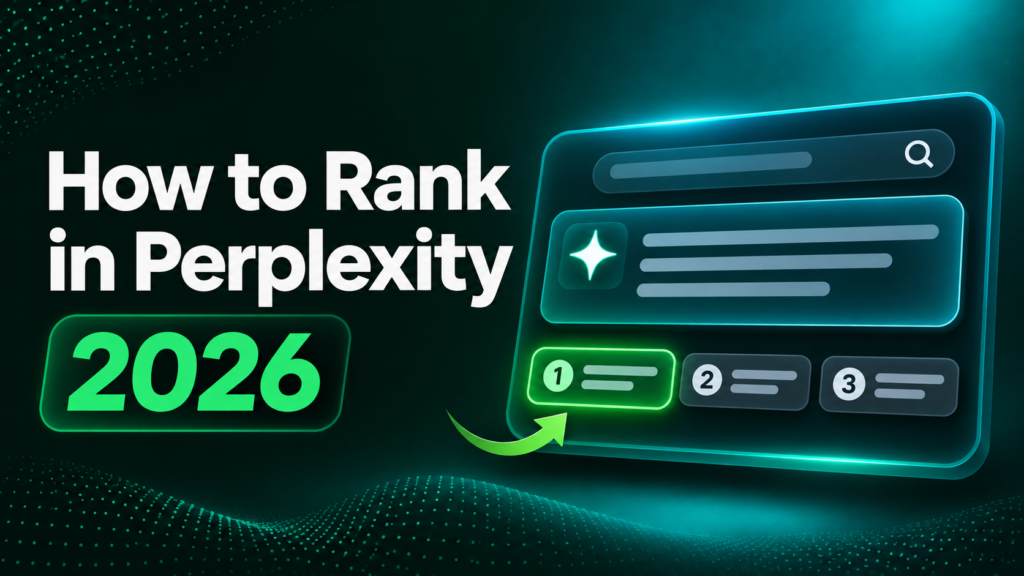
Here is how to rank in Perplexity: let PerplexityBot crawl your site, write pages in short sections that each answer one question on their own, keep them updated, back every claim with numbers and sources, and get your brand mentioned on the sites Perplexity cites most, led by Reddit and YouTube. “Ranking” in Perplexity means being one of the numbered sources it cites in an answer, and Perplexity picks those sources very differently from the way Google ranks ten blue links.
This guide explains how Perplexity chooses its sources, the 9 steps that get your pages cited, what doesn’t help, and how to check whether it’s working.
Key takeaways
- Perplexity runs its own search index of hundreds of billions of webpages and scores small passages of each page, not the page as a whole.
- Crawl access comes first: if your robots.txt or firewall blocks PerplexityBot, your pages can’t appear in its search results.
- Passages win citations: a section that answers one question in its first two sentences is easier for Perplexity to pick than a long page that circles the point.
- Fresh content gets cited more: Perplexity’s citations are on average 250 days newer than the pages ranking in Google’s organic results.
- Off-site mentions matter: Reddit, YouTube and Wikipedia earn 46% of the citations among Perplexity’s 50 most-cited websites.
In this guide
- How Perplexity chooses its sources
- How to rank in Perplexity: 9 steps
- What doesn’t help
- Perplexity vs Google: what’s different
- How to check if Perplexity cites you
- Frequently asked questions
How Perplexity chooses its sources
Perplexity is an AI answer engine. Instead of showing a list of links, it writes an answer and adds numbered citations to the pages it used. In June 2025, its CEO said Perplexity handled 780 million queries in May alone, and that number was growing more than 20% a month.
Three facts from Perplexity itself explain how a page gets picked:
- It searches its own index. When Perplexity opened its search infrastructure to developers in September 2025, it described an index covering hundreds of billions of webpages, processing tens of thousands of updates every second.
- It scores passages, not whole pages. In the same announcement, Perplexity explains that its system “divides documents up into fine-grained units,” and that each unit is scored on its own against the question. One strong section can earn a citation even if the rest of the page covers other things.
- It uses two crawlers. PerplexityBot builds the search index, and Perplexity recommends allowing it in robots.txt. Perplexity-User visits a page when a person’s question needs it, and generally ignores robots.txt because a user asked for the fetch. Perplexity states that neither one collects content to train AI foundation models.
So the path to a citation is simple: PerplexityBot has to reach your page, one passage on that page has to answer the question better than the alternatives, and the page has to look current and trustworthy.
How to rank in Perplexity: 9 steps
1. Let PerplexityBot crawl your site
Perplexity recommends allowing PerplexityBot in your robots.txt. Sites often block AI crawlers without knowing it, through an old robots.txt rule, a security plugin or a firewall setting. Add this to your robots.txt if PerplexityBot is blocked:
User-agent: PerplexityBot
Allow: /
If you use a firewall such as Cloudflare, allow PerplexityBot there too. Perplexity publishes its crawler IP ranges and says robots.txt changes can take up to 24 hours to take effect. Check your setup in seconds with the free AI Crawler Checker, which shows whether PerplexityBot, Perplexity-User and the other AI crawlers can reach your site.
2. Put your main text in plain HTML
If your article only appears after JavaScript runs, a crawler that reads the raw HTML may see an almost empty page. Make sure your headings, paragraphs and tables are in the HTML your server sends. Most WordPress sites already do this. Sites built as single-page apps should use server-side rendering for their articles.
3. Answer the question in the first two sentences of each section
Because Perplexity scores passages, each section should open with the direct answer, then explain it. Compare these two openings for “how much does a website audit cost” (the numbers are only an example):
- Weak: “Website audits are an important part of any SEO strategy, and many factors can affect what you pay.”
- Strong: “A website audit costs $500 to $5,000 for most small business sites. The price depends on the number of pages and whether the audit includes fixes.”
The strong version is a complete, quotable answer. Perplexity can lift it into a response and cite you for it.
4. Make every section stand on its own
A passage that says “as mentioned above” or “this tool” loses its meaning when it is pulled out of the page. Write each section so it makes sense alone:
- Use question-style headings that match how people ask, such as “How long does a site migration take?”
- Name the subject in full instead of “it” or “this” at the start of a section.
- Keep one idea per section, in roughly 40 to 150 words.
- Use lists and tables for steps, prices and comparisons. They are easy to quote accurately.
5. Keep your pages fresh, and show the date
Ahrefs analyzed nearly 17 million citations and found that AI assistants cite content that is 25.7% fresher than Google’s organic results. Perplexity’s citations were 250 days newer than organic results on average, and its in-text citations are usually ordered newest first.
That doesn’t mean changing the date on an old post. Update the facts, prices, screenshots and examples, then show a clear “Updated” date on the page. Revisit your most important pages every 3 to 6 months.
6. Add statistics, quotes and named sources
The research paper that named generative engine optimization, GEO: Generative Engine Optimization (Princeton, Georgia Tech, the Allen Institute for AI and IIT Delhi, KDD 2024), tested its methods on Perplexity itself. Adding statistics, adding quotations and citing sources raised visibility in Perplexity’s answers, with gains of up to 37% on one of the paper’s measures. Keyword stuffing performed 10% worse than doing nothing.
In practice: replace vague claims with numbers, name the study or person behind each number, and link to the original source. Your own data is even better, because no one else can supply it. You can learn more about these techniques in our guide to what GEO is.
7. Be present where Perplexity looks most
Perplexity doesn’t only cite brand websites. In Ahrefs’ study of the 50 most-cited websites in Perplexity (over 3.1 million US queries, updated November 2026), three sites lead by a wide margin:
| Website | Share of citations among the top 50 |
|---|---|
| reddit.com | 24.6% |
| youtube.com | 14.2% |
| en.wikipedia.org | 7.2% |
If people discuss your topic on Reddit, answer helpfully there and mention your brand only where it truly fits. If your buyers watch videos, publish YouTube videos that answer the same questions as your articles, with clear titles and descriptions. Our guide on how to get mentioned by AI on Reddit, YouTube and LinkedIn covers each platform step by step.
8. Get listed on the sites that rank your category
For “best” and “top” questions, Perplexity regularly cites review sites, directories and comparison articles. Search your main buyer questions in Perplexity, open the cited sources, and note the ones where you could appear: an industry directory, a review platform, or a list article whose author accepts suggestions. A listing on a page Perplexity already trusts is often the fastest route into its answers.
9. Track your citations and fix the gaps
Perplexity’s answers change as its index updates, so one manual check isn’t enough. Track the same buyer questions every week and watch which brands Perplexity names and which sites it cites.
ReadRankAI’s AI Visibility does this for Perplexity, ChatGPT, Gemini, Claude and Google AI Overviews in one place. It shows every buyer question where Perplexity recommends a competitor, the sites AI cites in those answers, and a fix plan for each gap. Before you publish, the GEO Optimizer gives each page a separate Perplexity score, so you can fix a weak page before it goes live.
What doesn’t help
- Repeating your keyword. The GEO research found keyword stuffing made pages less visible in Perplexity’s answers, not more.
- Counting on llms.txt. Perplexity’s crawler documentation doesn’t mention llms.txt, and large studies found AI bots rarely request the file. See what llms.txt is and whether you need one.
- Blocking Perplexity to protect your content. Perplexity-User generally ignores robots.txt because a person asked for the page, so a block barely protects anything. Blocking PerplexityBot only removes your pages from Perplexity’s search results.
- Changing dates without changing content. Freshness helps because the information is current. A new date on old facts gives readers and AI engines nothing new.
Perplexity vs Google: what’s different
| Google search | Perplexity | |
|---|---|---|
| What “ranking” means | A position in a list of links | Being a numbered source inside an AI answer |
| What gets scored | Pages, with passage ranking for some queries | Small passages of every page |
| Freshness | Least influenced by freshness in Ahrefs’ study | Cites content 250 days newer than organic results |
| Other sites’ role | Links to your pages are a major signal | Reddit, YouTube and Wikipedia take a large share of citations |
| Crawler | Googlebot | PerplexityBot (index) and Perplexity-User (live fetches) |
The good news: the work overlaps. Clear answers, real expertise, current facts and strong sources help you on Google too. Our comparison of SEO vs GEO explains where the two meet.
How to check if Perplexity cites you
- List 10 to 20 buyer questions your customers ask before they choose a product or service like yours.
- Ask each one in Perplexity and note whether your brand is named and whether your site is among the cited sources.
- Open the cited pages for answers that name a competitor. They show what Perplexity trusts for that question.
- Repeat weekly, or automate it, because answers shift as the index updates.
For the full method, see how to track your brand in ChatGPT and AI search. To see where your content stands today, check your GEO score free.
Frequently asked questions
How does Perplexity choose its sources?
Perplexity searches its own index of hundreds of billions of webpages, splits each page into small passages, and scores those passages against the question. It then cites the pages whose passages best answer it. Crawl access, a clear answer in the passage, freshness and trustworthy sources all affect the choice.
Does Perplexity use Google’s results?
Perplexity says it runs its own search index, crawled by PerplexityBot, and offers that same infrastructure to developers through its Search API. Ranking well on Google can still help indirectly, because pages that earn links and mentions tend to be found and trusted by AI engines too.
Should I block PerplexityBot?
Only if you don’t want to appear in Perplexity at all. Blocking PerplexityBot removes your pages from Perplexity’s search results. Perplexity states that PerplexityBot doesn’t collect content to train AI foundation models. Allowing it is about appearing in answers.
How long does it take to get cited in Perplexity?
There is no fixed time. Robots.txt changes can take up to 24 hours to reach Perplexity’s systems, and a new or updated page has to be crawled before it can be cited. Specific questions with few strong answers are usually easier to win than broad, competitive ones.
Can a small website rank in Perplexity?
Yes. Perplexity scores passages, so one clear, well-sourced answer from a small site can be cited next to big brands. The GEO research also found that adding statistics, quotes and sources raised visibility in Perplexity’s answers, and those are changes any site can make.
How do I know if Perplexity cites my website?
Ask your buyer questions in Perplexity and check the numbered sources under each answer. To track it every week across Perplexity, ChatGPT, Gemini, Claude and Google AI Overviews, use ReadRankAI’s AI Visibility, which shows each answer, the sites cited and what to fix.